InfraNode: Engineering an Enterprise IT Asset & Infrastructure Health Dashboard
Most IT teams manage their hardware through a patchwork of spreadsheets, email threads, and disconnected tools. We built InfraNode to replace that patchwork with a single, self-hosted dashboard that tracks every asset, monitors infrastructure health in real time, and governs procurement requests from submission to fulfilment.
The Infrastructure Visibility Problem
Ask any IT administrator where a specific server is in its lifecycle, and you are likely to get a long pause followed by a spreadsheet attachment. Asset registers, warranty records, and end-of-life dates live in separate files maintained by separate people. Equipment requests are submitted by email and tracked, if at all, in someone's inbox. Health monitoring is either absent or locked behind expensive enterprise tooling.
The result is a team that is always reacting. A server fails because its EOL date was missed. A procurement request gets lost. A critical alert goes unnoticed because there is no single place to look.
InfraNode was built to fix this. It consolidates asset inventory, lifecycle tracking, telemetry health signals, system alerts, and equipment procurement workflows into one unified, browser-based interface that any IT team can self-host with nothing more than a Supabase project.
What is InfraNode?
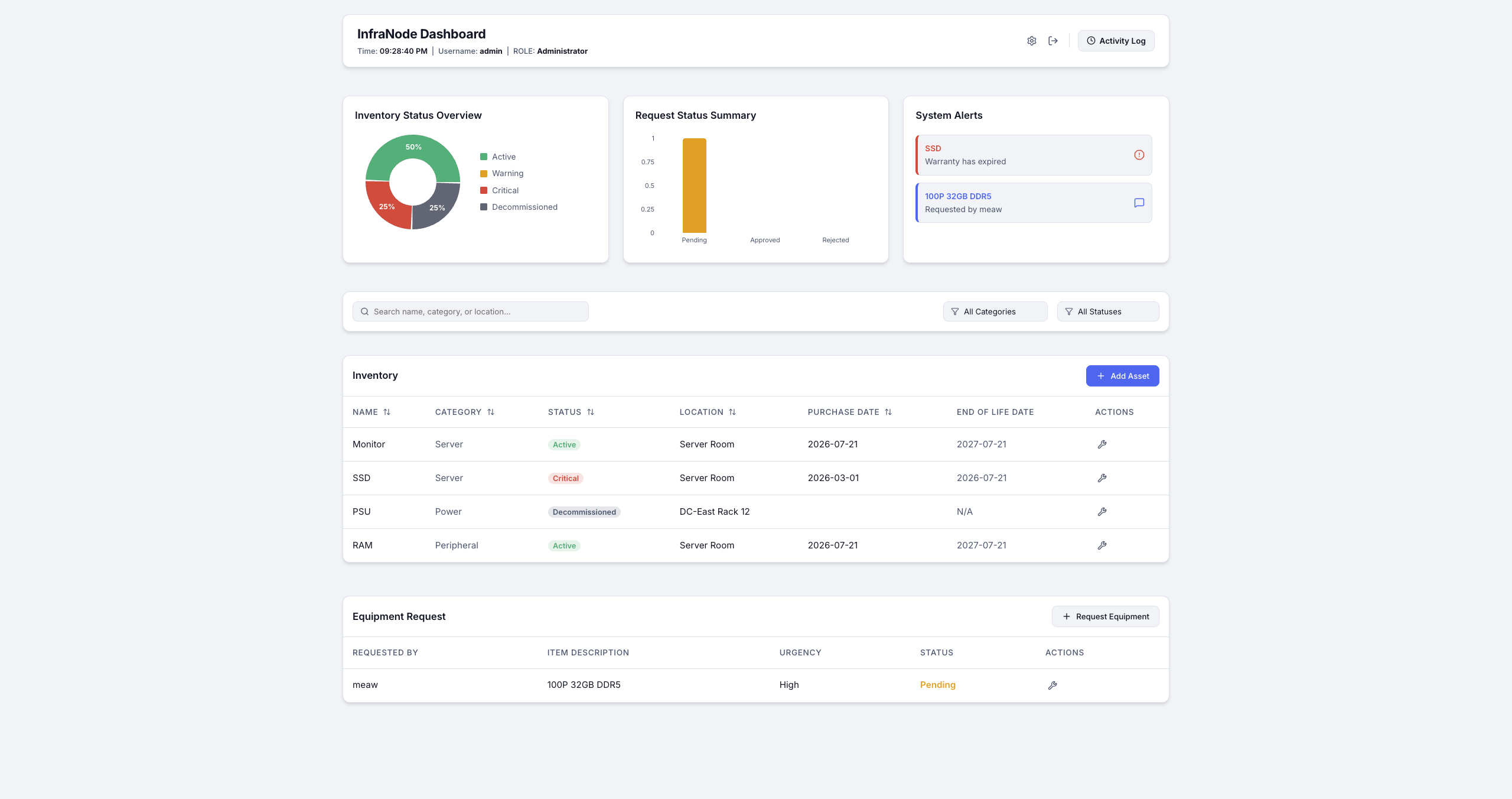
InfraNode is a full-stack, browser-based IT asset governance platform for enterprise IT teams. It provides real-time visibility into hardware inventory across 10 asset categories and 4 operational statuses, with automatic lifecycle escalation, live telemetry monitoring, and a complete equipment request workflow built in.
At the heart of InfraNode is an interactive dashboard that surfaces executive-level KPIs at a glance: asset status distribution, request pipeline health, Recharts-powered charts, system alerts sorted by severity, and a live telemetry feed showing CPU temperature, voltage, and utilization per asset.
We designed InfraNode to be immediately useful without configuration overhead. It runs on Supabase PostgreSQL with real-time subscriptions, so asset changes sync instantly across every active session without polling.
How InfraNode Works
1. Manage Your Asset Inventory
Administrators can create, update, and decommission hardware assets from a central inventory view. Each asset is assigned a category (Server, Network, Storage, Workstation, Laptop, and more), an operational status, a location, and an End-of-Life date. Live search with debouncing, category and status filters, and one-click CSV export make the inventory practical to work with at any scale.
2. Let the System Watch Lifecycle Dates
InfraNode monitors every asset's End-of-Life date automatically. Assets within 14 days of their EOL are flagged as Warning. Assets that have passed their EOL are escalated to Critical without any manual intervention. This means lifecycle risk surfaces to your dashboard before it becomes a failure.
3. Monitor Infrastructure Health in Real Time
The telemetry layer pulls live hardware health data from the Supabase telemetry table continuously, tracking CPU temperature, voltage, and utilization per asset. The system alerts panel aggregates critical signals in one place, sorted by severity, so operators always know which asset needs attention first.
4. Handle Equipment Requests End to End
Employees can submit equipment procurement requests directly from the dashboard, specifying item details, business justification, and urgency level. Administrators review requests through a dedicated modal and move them through a governed status flow: Pending to Approved or Rejected, and then to Fulfilled. Every decision is logged to the audit trail.
Key Highlights & Takeaways
- Automatic EOL lifecycle escalation with a 14-day proactive warning window, no manual monitoring required.
- Real-time asset sync via Supabase Broadcast channels, keeping every active session consistent without polling.
- Live telemetry monitoring of CPU temperature, voltage, and utilization per hardware asset.
- Full equipment request workflow with a governed Pending to Approved to Fulfilled status flow and admin review modal.
- Offline-first hybrid data layer that merges Supabase records with localStorage, ensuring zero disruption if remote connectivity is lost.
Technical Case Study: Architecture Decisions
InfraNode is built on React 19 with Vite, structured around single-responsibility layout, component, and context modules. Data fetching and mutation logic are encapsulated in custom hooks (useAssets, useRequests, useTelemetry) that stay entirely separate from presentational components. Global state, including authentication clearance, theme tokens, and toast notifications, is managed through top-level React Context providers.
The backend is Supabase PostgreSQL with four tables: assets, telemetry, action_logs, and asset_requests. Row Level Security is enabled on all four. Real-time subscriptions use Supabase Broadcast channels to emit and receive asset change events instantly across all active client sessions.
One deliberate design decision was the offline-first hybrid data layer. Asset hooks perform optimistic UI updates locally first, then dispatch asynchronous mutations to Supabase. If remote connectivity is lost, the application falls back to localStorage seamlessly, so operators continue working without interruption. This makes InfraNode reliable in the kinds of network environments where IT infrastructure teams actually operate.
A custom toast notification system provides immediate, non-blocking feedback for every user interaction. Rather than using a third-party library, we built it in-house to match the dashboard's interaction model and keep the bundle lean.
Conclusion & Next Steps
InfraNode demonstrates that unified infrastructure governance is accessible without massive software budgets. It provides real-time asset tracking and telemetry monitoring out of the box, giving IT teams complete visibility and control in a self-hosted package they can manage entirely themselves.
The live demo is available at infranode.riyadhalmahmud.tech and the full source code is published on GitHub. Whether you are an IT manager seeking a lightweight asset tool, a developer studying real-time React architectures, or a team migrating off spreadsheets, InfraNode provides a solid foundation.

About nodedCode Studio
We are a forward-thinking digital studio specializing in high-performance web engineering and advanced technical architectures for the modern digital space and Web3 ecosystem.
Start your project